Why True Emergence Requires Two Things We Rarely Talk About: A Subconscious, and a Reset Button

We all talk about emergent properties in evolution, intelligence, and now AI. But most explanations focus on surface-level mechanics—complexity, mutation, selection pressure, etc. Those matter, but they’re not the root cause of emergence.
Emergence appears when two deeper conditions exist:
**1. A Subconscious + Conscious Divide
(Selective Focus Without Needing All the Data)**
Humans (and many animals) don’t think with all available information at once.
We operate with two layers:
- A subconscious running millions of parallel processes automatically
- A conscious layer that selectively focuses on one or two problems at a time
This separation is what enables emergent abilities like:
- creativity
- abstract reasoning
- tool-making
- planning
- morality
- culture
Without a subconscious handling the “baseline complexity” of survival, the conscious mind would have no bandwidth left for innovation.
In emergence, this selective attention is the unlock:
the system devotes energy to solving higher-order problems without being overwhelmed by fundamentals.
It’s similar to why companies with strong infrastructure can innovate faster—they aren’t busy reinventing plumbing every day.
**2. Reproduction as a Reset
(Innovation Through Partial Inheritance, Not Full Transfer)**
The second requirement is even more counterintuitive:
👉 Emergence requires generational “blank slates.”
In nature, offspring don’t inherit the fully trained model of the parent.
They inherit:
- base wiring
- survival instincts
- a starting world-model—nothing more
This partial inheritance is the secret to emergence.
It creates the space for novelty, mutation, and innovation.
It allows each new organism to explore a slightly different configuration of reality.
Contrast that with how humans hire:
- CEOs selected for experience
- Engineers selected for mastery
- Leaders selected for proven track records
In business, we avoid resets.
In evolution, resets are the mechanism that creates new capabilities.
Emergent properties require freshness—a generational opportunity to remix the rules. We operate in a world of experience, mastery and track records, unable to process freshness based upon our own limited life time. Time builds emergent properties, not experience, mastery or track records.
How the Classic Conditions Support These Two Principles
Once you accept these two primary forces, all the traditional biological ingredients fall neatly underneath them:
Complexity + Nonlinear Interactions
→ Feed the subconscious so the conscious layer can focus.
Genetic variation + Mutation
→ Provide the raw material for innovation during generational resets.
Selective pressure
→ Rewards emergent behaviors that increase survival.
Distributed processing
→ Mirrors subconscious parallelism found in the brain.
Feedback loops + Learning systems
→ Reinforce successful behaviors within each generation.
Internal world-models
→ Bridge subconscious patterning and conscious inference.
Together, they support the two required pillars of emergence:
- A dual-layer architecture that divides attention
- A reproduction mechanism that encourages novelty instead of copying
Why This Matters for AGI
Today’s AI systems violate both rules.
1️⃣ LLMs have no subconscious layer.
They must process everything at once. They cannot selectively focus.
And without a subconscious world-model, hallucination is inevitable.
2️⃣ They do not reproduce with partial inheritance.
Models don’t create new models with fresh structures;
they merely accumulate weights through more training.
AGI will not emerge from scaling token prediction.
It will emerge from building systems that:
- have layered cognition (subconscious + conscious)
- generate new, partially inherited models (true evolutionary resets)
- learn by noticing what they don’t know
- reason about incomplete information rather than hallucinating filler
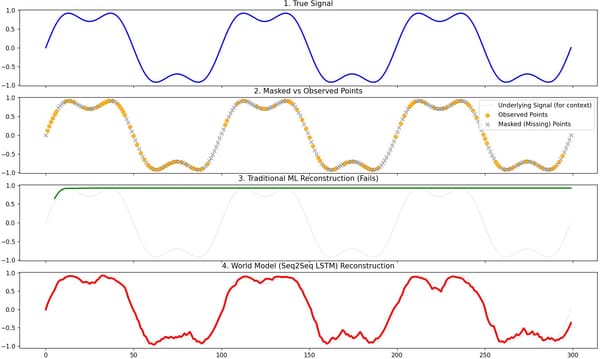
This is why Active Models—and world-model approaches more broadly—represent the next frontier. They introduce autonomy, selective focus, self-supervised learning, and the ability to infer what is missing rather than repeat what is known.
Emergence Isn’t a Mystery. It’s a Structure.
To get real emergent intelligence—biological or artificial—we need:
A subconscious to carry the complexity.
A fresh start every generation to spark innovation.
Everything else is just the machinery underneath.
If we want systems that don’t just predict the next token, but generate the next idea,
this is the architecture we must build.